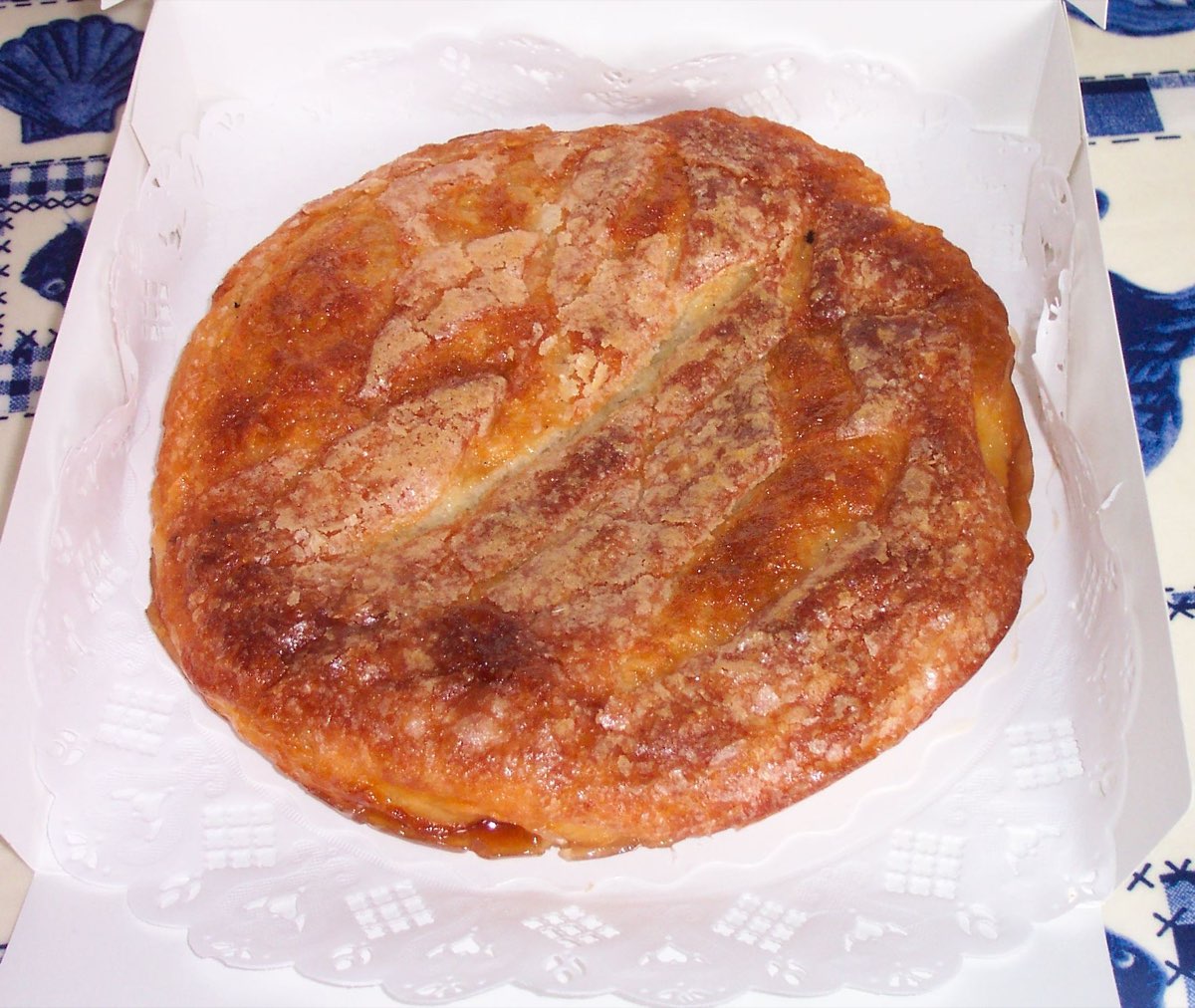
Kouign-amann
Ingredients
- 500 g bread flour
- 10 g salt
- 10 g instant yeast
- 300 ml water
- 375 g cold butter (for lamination — about 75% of the flour weight)
- 200-250 g granulated sugar (for folding in and for the pan)
Kouign-amann comes from Douarnenez in Brittany, and its name literally means 'butter cake' in Breton. Unlike croissant dough, its base is lean — just flour, water, yeast and salt, with no milk, eggs or butter mixed in. All of the richness comes from laminating in a large block of butter and, on the final fold, a generous layer of sugar, which caramelizes in the oven into a shatteringly crisp, almost glazed crust.
Method
Mix flour, salt, yeast and water into a smooth, lean dough. Rest, then chill.
Pound the cold butter into an even slab and encase it in the dough, as for croissants.
Roll and fold in thirds, chilling between turns, for two turns.
On the final turn, sprinkle a generous, even layer of sugar over the dough before folding it in, so the sugar becomes part of the lamination.
Roll the dough out, cut into squares, and fold the corners of each square toward the center.
Place into well-buttered, sugared muffin tins or individual molds and proof until puffy.
Bake at around 200-220°C (400-425°F) for 35-45 minutes, until deeply caramelized and dark golden — the sugar should have visibly caramelized on the surface.
Cool briefly in the tin before unmolding, as the caramel sets hard as it cools.
Ingredients
- 472 g bread flour
- 12 g salt
- 4 g instant yeast
- 296 ml water
- 1 tbsp butter (for the dough) plus 364 g cold butter (for lamination)
- 360 g granulated sugar, for laminating and coating
Dominique Ansel, the French pastry chef behind the Cronut, is widely credited with introducing kouign-amann to American audiences through his New York bakery's 'DKA' (Dominique's Kouign-Amann), sold there since 2011. His version starts from a yeasted dough laminated much like croissant dough, then works sugar into the lamination across two additional rounds of folding rather than just one, before the dough is cut into squares, folded envelope-style, and baked upright in individual ring molds so each one caramelizes on every side.
Method
Combine the flour, salt, water, the 1 tablespoon of butter and the yeast; mix on low for 2 minutes, then on medium-high for about 10 minutes until smooth with full gluten development.
Let rise at room temperature, covered, until doubled, about 1 hour.
Fold the edges to the center, press into a 10-inch square, and freeze for 15 minutes per side to firm up.
Spread the cold lamination butter into a 7-inch square on parchment and chill until firm but still pliable.
Encase the butter block in the dough diamond-style, seal the edges, and roll out to about 24×10 inches. Perform three letter folds, chilling 30-40 minutes between each.
On the last two folds, sprinkle sugar over the dough before folding, so the sugar becomes part of the lamination.
Cut the laminated dough into 4-inch squares, fold each corner in to the center twice, and place in sugared ring molds on a sugared tray.
Proof for 15-20 minutes, until slightly puffy.
Bake at 185°C (365°F) conventional, or 171°C (340°F) convection, for 15 minutes, rotate the tray, then bake 15 minutes more until deeply golden.
Unmold immediately while hot and cool upside down; best eaten within a few hours of baking.